 Waiting at the train station was Helma the transplanted Dutch now living in Florence with a neatly printed sign announcing she was with Liberty Travels. After a quick breakfast we were off to downtown Florence taking the city bus like we were pros. What a beautiful city! Can you spell M-E-D-I-C-I? Well they ruled in the 15th century with their "enforcer" Kosimo the Duke. He was simply put, an ass kicker but a renaissance kind of guy. He promoted the arts, kissed the Medici's butt and got his likeness in a number of paintings.
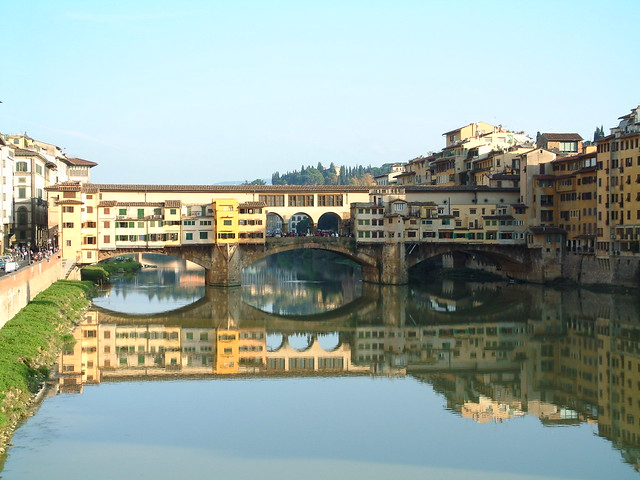
 As you drive into the main part of two you come to Ponte Vecchio a beautiful bridge that has had its share of floods and events during WW2. Apparently Hilter was so in love Florence art that he scampered off with the best pieces when he knew the game was up. Spanning the Arno River, the Ponte Vecchio is one of Florence’s oldest and most photographed bridges. Noted for its three segmented arches, the bridge was first built by the Etruscans and later rebuilt in the 14th century. The bridge’s most striking feature is the line of high-end jewelry shops flanking along each of its edges. Many visitors come here to shop and take photographs. Night time presents stunning views when the lighting from the bridge is reflected upon the water. Off to the right of the picture is the famous Uffizi Gallery which among other paintings and sculptures has the famous David replica on the outside. Apparently, the "real" David was always placed outside the Uffize but for various reasons was moved inside. Back to Hitler: never understood why the Italians believed Hitler pillaged Florence because heck they were on the same side. Perhaps this was just a way to show that Italians were always good at heart. Florence has been besieged by damaging floods dating back to the 15th century. The most recent one in 1966 caused widespread destruction, destroyed several masterpieces and also reuired vast restoration efforts. A mark at one of the Piazzos shows the level of the flood water ins 1966: at least 15 feet above the ground.
 Kosimo the Duke was a big patron of the arts but in a very mendacious way. He always was looking for himself even as he ingratiated to the Medici's who were powerful and could eliminate their enemies. But Kosimo was able to marshal a lot of power and alos made sure that one Michael Angelo was well taken care of. MA had extraordinary powers, combined with his "arrogance" that he was the best. When confronted with the raw material marble provided him to carve David, he scoffed at the challenge and proceeded to sculpt his masterpiece. To master the human body, MA was known to examine cadavers at the local mortuary to assure proportions and musculature were accurately represented. As you go around David, you notice the attention to detail, the details of the facial expression, the weapons he is about to load to slay Goliath and frankly the apprehensiveness of his mission.As you walk around the statue inside the Pallacio he cant help but notice how painstaking the effort must have been. Various times in history, people have tried to vandalize the statue: one such endeavor resulted in a portion of his toe being disfigured. We saw the same damage inflicted on the Piata in Rome when an unbalanced on-looker also had a go at the statue. Now very elaborate screens and electronic alarms prevent such excesses
Santa Maria del Flore
Dominating the panoramic view of Florence is the Santa Maria del Fiore, the domed cathedral that is often called the Duomo. Known today as the world’s largest masonry dome, this majestic cathedral features 600 years worth of stunning architecture and art works. From its beautiful Gothic facade of red, green and white marble to its elaborate interior of stained-glass windows, mosaics, frescoes and bronze statues, the Duomo complex also includes the impressive structures of the Baptistery and Giotto’s bell tower. A climb to the top rewardx tourists with panoramic views of Florence and outlying valley.
The Uffizi Gallery
Regarded today as one of the world’s greatest art museums, the Uffizi
 Gallery is located off the Piazza della Signoria. This former palace was first built in 1560 to house the offices of the city magistrates. After the ruling dynasty of the Medici family relinquished its power, the palace evolved into an art gallery to showcase its stunning collection of Renaissance art treasures. Opened to the public since 1765, the museum offers thousands of art works by masters like Michelangelo, Botticelli, Leonardo da Vinci and Titian.
 No doubt Kosimo the Duke was the power broker on what could be exhibited and where at the Uffizi (literally means the "office"). Outside the gallery is the aforesaid likeness of the David as well as fascinating fountain where he dominates riding a horse. In the middle of the fountain is Neptune the God of the Sea and a little bit of examination of his face reveals he looks a lot like Kosimo! Well that was Kosimo's callin card. He made his likeness both unobtrusive but sometimes pretty bluntly obtrusive! The statues are located in the Piazza della Signoria which consists of an open-air exhibit of other famous sculptures: the Rape of the Sabine Woman, Perseus with the head of Medusa are gloriously displayed open air in this Piazza,
 One of Florence’s most significant buildings is the Palazzo Vecchio, a grand palace overlooking the Piazza della Signoria. Built in the 12th century, the Palazzo Vecchio housed the powerful Medici family as well as Florence’s supreme governing body for six centuries. Since 1872, it has served in part as a museum and as the city town hall. This impressive palace packs a wealth of artifacts and art works that include beautiful frescoes, sculptures, painted ceilings, intricate carvings and tapestries that all depict historic and Biblical events.
.
Situated at the center of the city’s main market district, the Basilica di San Lorenzo is one of the oldest churches of Florence and was the burial place of all the principal members of the Medici family. The church, originally designed by Filippo Brunelleschi in the 15th century, is an early example of ecclesiastical Renaissance architecture. The façade of this church was never completed, giving it a striking, rustic appearance. Inside the church is pure Renaissance neo-classical splendor.Near the Nuevo Mart there are many street vendors selling scarves, caps, and thingmajigs. These are run by Bangladeshi vendors and we saw them in Rome as well. Another indoor eatery had the best pizzas and cheese. That shop was managed by a Korean, Brazilian and a Chinese woman. Globalization is everywhere!


 On the northern side of the Lagoon are wonderful natural landscapes, with beaches that change color depending on the sunlight, just like the Dolomites that have nourished, over the centuries, this beautiful coastline.